

LGBTQIA+ Mental Health: A Guide to Queer-Affirming Care
- Queer-affirming care means treating a person's sexual orientation and gender identity as natural, healthy parts of their identity, rather than something that needs to change.
- LGBTQIA+ people face a well-documented mental health gap, driven by societal stigma and discrimination.
- Affirming care measurably protects LGBTQIA+ mental health, whether it comes from a therapist, a parent, a teacher, or a single supportive adult.
- Queer LifeSpace puts these principles into practice through sliding-scale therapy and dedicated support groups.
This guide explains what queer-affirming care looks like beyond simply being LGBTQIA+-friendly. It covers the mental health disparities LGBTQIA+ people face, the support that can make a difference, and what affirming support looks like at Queer LifeSpace.
For LGBTQIA+ individuals, mental health can be shaped by experiences that traditional therapy doesn’t always account for, like discrimination, family rejection, or having to think about when it feels safe to be fully yourself. Affirming care is designed with those realities in mind.
In this guide, we’ll look at what affirming care means, what the research tells us, and how Queer LifeSpace puts these principles into practice.
Here’s what we’ll cover:
Affirming care changes outcomes for LGBTQIA+ people, and affordability is a big part of that. Your donation helps keep it within reach for the Bay Area community.
Donate to Make Care PossibleWhat is queer-affirming care?
Queer-affirming care starts with a simple idea: being LGBTQIA+ isn’t something that needs to be fixed or treated. A person’s sexual orientation and gender identity are normal parts of who they are. The American Psychological Association (APA) describes affirming practice in much the same way, recognizing sexual minority identities as normal variations of human experience rather than something that requires intervention.
But affirming care goes beyond having a therapist who is simply accepting or LGBTQIA+-friendly. These principles align with specific, documented practices, such as the APA's official transgender and gender nonconforming client guidelines and its sexual minority persons guidelines.
In an affirming therapy room:
The therapist asks about pronouns during intake instead of making assumptions based on a client’s name or appearance, and uses those pronouns consistently.
Intake forms give clients space to share their name and gender rather than limiting them to binary options.
When exploring what’s causing distress, the therapist considers the effects of stigma, discrimination, and minority stress.
The therapist asks about important relationships beyond biological family, including chosen family and other sources of support.
A client’s choice not to come out to family is respected. It isn’t treated as something they need to work toward.
The therapist pays attention to their own language and assumptions around gender and sexual orientation, rather than putting the responsibility on the client to correct them.
It's different from general therapy that happens to be "open" to LGBTQIA+ clients. Affirming care is built around these practices from the start.
Why is LGBTQIA+ affirming care important?
Affirming care can make a meaningful difference in LGBTQIA+ mental health. So what’s behind the disparities in the first place? And what does the research actually tell us about affirming care? The sections below dig into the causes, the mental health effects, protective factors, and the evidence behind affirming approaches.
LGBTQIA+ people face higher rates of depression and anxiety
LGBTQIA+ people experience depression, anxiety, and other mental health conditions at higher rates than the general population. This pattern has shown up consistently in mental health research for decades, across different age groups, income levels, and geographic areas.
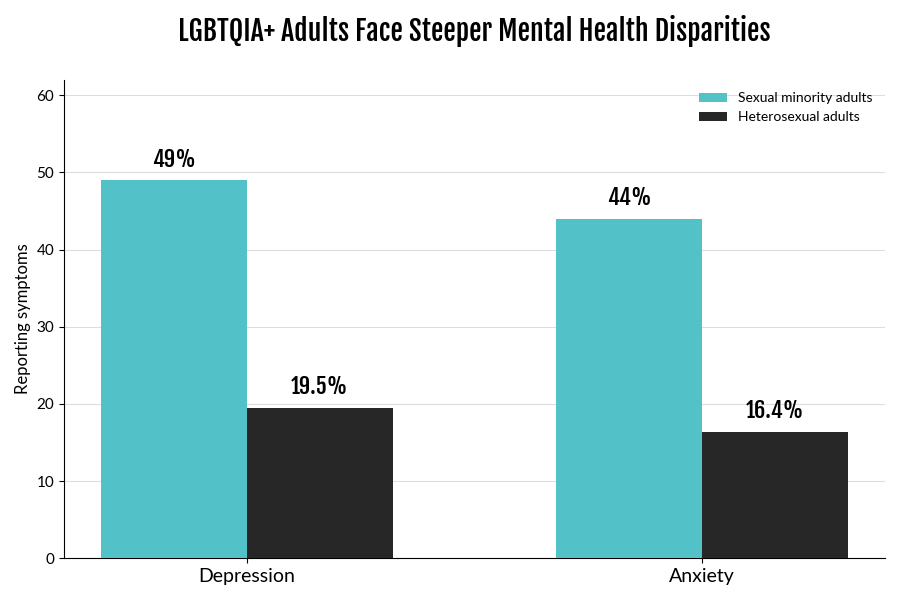
A 2022 national health survey analysis found that nearly half of sexual minority adults screened positive for depression (49%) and anxiety (44%), compared to about a fifth of heterosexual adults. Researchers point to minority stress as the reason for this gap: the strain that can come from discrimination, rejection, and having to constantly think about when, where, and how safe it is to be open about your identity.
Affirmation protects LGBTQIA+ mental health
Affirmation isn’t just about making someone feel accepted. Research shows that specific forms of support and affirmation can have a measurable, positive impact on LGBTQIA+ mental health.
Some of the factors linked to better outcomes are:
Respected pronouns and chosen names. A peer-reviewed study of transgender youth found that having even one context where a chosen name could be used was linked to a 29% decrease in suicidal thoughts.
Affirming community resources. Adolescents living in communities with more LGBTQ+-supportive resources, youth organizations, events, and inclusive businesses, show a consistently lower risk of a past-year suicide attempt across nearly every group studied.
Inclusive education. A systematic review of 44 studies found that Gender and Sexuality Alliances and inclusive school context are linked to reduced suicide-related thoughts and behaviors among LGBTQIA+ students.
Supportive families. LGBT young adults with high levels of family acceptance report significantly lower rates of depression, substance abuse, and suicidal ideation than those with low family acceptance.
Missing support. Without these factors, risk compounds. LGBTQIA+ young people overall face notably higher risk than their peers, largely tied to rejection and a lack of affirming spaces.
What these examples have in common is the power of feeling supported and affirmed, whether from a parent, a teacher, a school policy, or a single supportive adult.
Research supports affirming care as effective treatment
Affirming support has a documented effect on mental health. A systematic review of affirming interventions found that nearly every study tracked showed improvement in mental health or overall well-being after someone received affirming care, including therapy.
These changes include:
Improved wellbeing, depression, or anxiety symptoms
Reductions in general psychological distress and dissociative symptoms
Better mental health outcomes independent of any formal treatment due to peer support and community connection
This is why Queer LifeSpace's therapists are trained specifically in affirming practice. The research shows that distinction is what produces results.
Common LGBTQIA+ mental health issues
LGBTQIA+ people experience several mental health conditions, some strongly influenced by stigma, discrimination, and rejection, while others may be more directly related to experiences of gender or sexual identity.

The most common include:
Depression and anxiety. Persistent low mood, loss of interest, or excessive worry that interferes with daily life.
Gender dysphoria. Psychological distress from a mismatch between gender identity and sex assigned at birth.
Internalized stigma. Absorbing society's negative attitudes about being LGBTQIA+ and turning them inward.
Substance use disorders. Using alcohol or drugs in ways that cause harm or impairment.
Trauma responses. Symptoms similar to PTSD from repeated discrimination or violence, even without one identifiable event.
Grief and isolation. Loss of relationships with unsupportive family, or navigating chosen family loss.
Compounded discrimination for LGBTQIA+ people of color. Combined racism and anti-LGBTQIA+ discrimination drive higher rates of anxiety and depression.
These conditions call for a therapist who understands how identity, stigma, and mental health can overlap – and knows how to account for those factors in treatment. Queer LifeSpace’s group therapy program takes that approach, with dedicated groups focused on many of the issues discussed above.
Common terms to know

A few terms come up often in conversations about queer-affirming care. Here's a quick gender identity terminology guide:
Affirming therapy: A therapeutic approach that supports a client’s sexual orientation and gender identity rather than treating them as something that needs to be changed.
Chosen family: The close relationships, often friends or community, that many LGBTQIA+ people build when the biological family isn't supportive or safe.
Cisgender: Someone whose gender identity matches the sex they were assigned at birth.
Coming out: The process of sharing one's sexual orientation or gender identity with others.
Gender identity: A person's internal sense of their own gender.
LGBTQIA+: An umbrella term covering lesbian, gay, bisexual, transgender, queer or questioning, intersex, asexual, and other sexual orientations and gender identities.
Minority stress: The added psychological strain that comes from stigma, discrimination, and prejudice, not from being LGBTQIA+ itself.
Sexual orientation: Who a person is sexually attracted to.
How does Queer LifeSpace provide LGBTQIA+ affirming care?

Queer LifeSpace offers sliding-scale therapy grounded in queer-affirming practice. Every therapist starts with the same understanding: a client’s identity isn’t something to question, debate, or change.
Queer LifeSpace’s core services include:
Individual therapy
Couples therapy
Group therapy, including identity-specific groups like Queer Women's Support, Queer BIPOC Support, and Gender Spectrum Support
If you're looking for care yourself, you can sign up for therapy and see current openings.
How can you support LGBTQIA+ mental health and affirming care?

Donating is the fastest way to fund affirming care, but it's not the only one. A few ways to get involved:
Give a one-time or monthly gift. Recurring donations help Queer LifeSpace plan sliding-scale therapy and clinical training further ahead. See ways of giving for options, including employer matching.
Volunteer your time. Queer LifeSpace relies on volunteers for events, outreach, and program support. Sign up to volunteer.
Spread the word. Share this page or Queer LifeSpace's work with someone who might donate, volunteer, or need affirming care themselves.
Practice affirmation in your own life. Use someone's correct name and pronouns, don't make assumptions about identity, and let queer people speak for themselves about their own experiences.
Fund someone's first affirming session.
Every gift supports sliding-scale therapy and the training that makes affirming care possible. Yours could be the one that gets someone in the room.
Donate to Make Care PossibleFrequently Asked Questions (FAQs)
-
Queer-affirming care is therapy and support that treats a client's sexual orientation and gender identity as healthy and valid, not as something to question or change. It supports the whole LGBTQIA+ community.
-
Regular therapy may be welcoming to LGBTQIA+ clients without being built around their specific experience. Affirming therapy revolves around the LGBTQIA+ experience, understanding minority stress, chosen family, and identity-specific concerns as part of the work.
-
No. Queer-affirming care applies to people across sexual orientation and gender identity, including lesbian, gay, bisexual, transgender, nonbinary, and other LGBTQIA+ identities. It's a broader concept than "gender-affirming care," a related term that specifically refers to support for gender identity and is more closely associated with transgender and nonbinary experiences. Queer-affirming care includes that, but also covers affirming support for sexual orientation.
-
Not at Queer LifeSpace! Therapy is offered on a sliding scale starting at $30 a session, so affirming care isn't limited to those who can pay full price.
-
Yes. Many affirming therapists work with family members, partners, or chosen family to help them better understand and support a loved one's identity, alongside or separate from individual therapy.