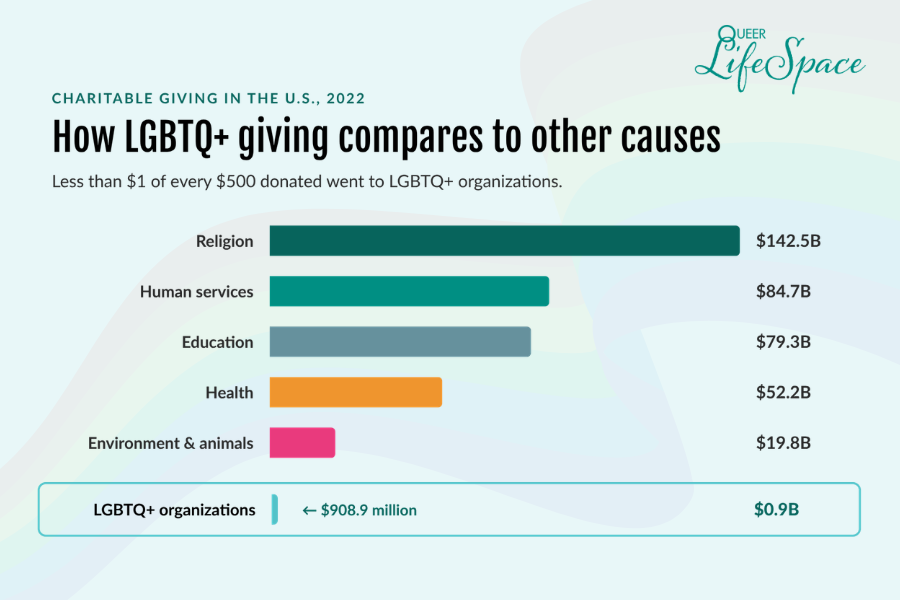
- Compared with charitable causes, LGBTQ+ organizations run on a much smaller base of support. In 2022, less than $1 of every $500 Americans gave to charity went to LGBTQ+ organizations, so every gift makes a real difference.
Read full summary ▾
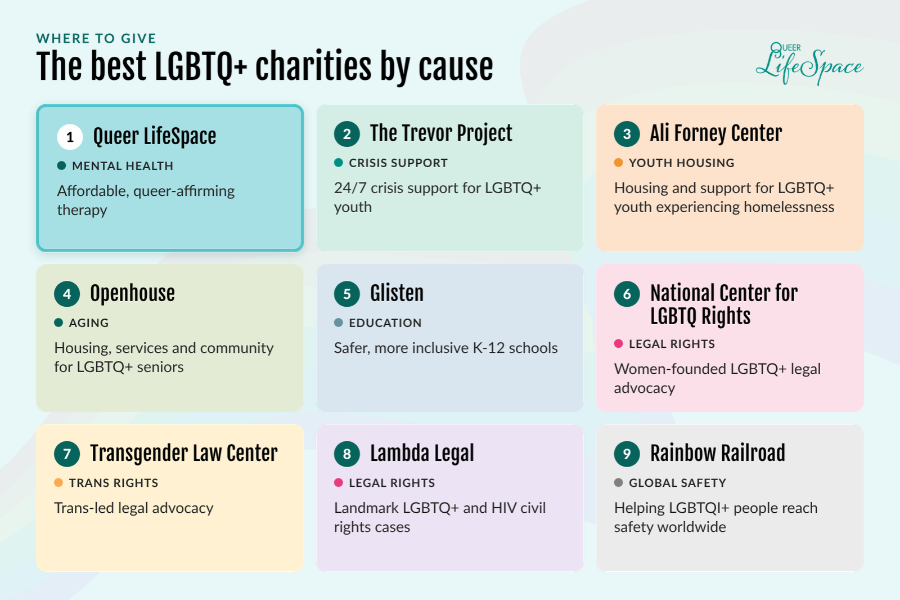
- This list covers nine LGBTQ+ charities, each with a different focus: affordable therapy, crisis support, youth housing, schools, legal rights, elders, and global safety. You can support one or several.
- Queer LifeSpace provides affordable, queer-affirming therapy in the Bay Area. It has served nearly 8,000 clients and trained more than 150 queer-affirming therapists.
- To vet a charity, check its 501(c)(3) status with the IRS, look up its profile on Candid or Charity Navigator, and read its annual report or Form 990.
- To make your gift go further, give monthly and ask about employer matching. Starting in 2026, non-itemizers can also deduct up to $1,000 ($2,000 if filing jointly) in cash gifts to certain qualified charities.
Learn what each organization does, who it serves, and what your donation supports, so you can give with confidence. We also cover what to look for in an LGBTQ+ charity and answer common questions about tax deductions, small gifts, and giving locally.
When you support LGBTQ+ communities, your gift goes a long way. It can help someone get therapy, find a safe place to stay, or connect with an accepting community.
This list brings together nine of the best LGBTQ+ charities, each with a different focus, so you can choose the cause that matters most to you. We start close to home with Queer LifeSpace in the Bay Area, then move to organizations working across the country and around the world.
We’ll discuss the following:
Where should you donate to support LGBTQ+ causes?
3. Ali Forney Center: Housing and support for LGBTQ+ youth experiencing homelessness
4. Openhouse: Housing, services and community for LGBTQ+ seniors
5. Glisten (formerly GLSEN): Safer, more inclusive K-12 schools
7. Transgender Law Center: Trans-led legal advocacy for trans and gender-nonconforming people
9. Rainbow Railroad: Helping LGBTQI+ people reach safety worldwide
Give today to support Queer LifeSpace’s low-cost therapy for LGBTQIA+ teens and adults across the Bay Area.
Donate TodayWhy do LGBTQ+ charities need your support?
LGBTQ+ charities receive a small share of U.S. giving, so they depend heavily on the individuals who do donate, rather than being able to count on a broad support base. In 2022, LGBTQ+ organizations received less than $1 of every $500 donated, about $908.9 million in total. Foundation support is limited too. In 2024, just 16 cents of every $100 in U.S. foundation grants went to LGBTQ+ communities.
Individual donors help fill that gap. A gift of any size helps fund the therapy, housing, legal help, and community programs these organizations provide, and keeps that work going year after year. The nine charities below each focus on a different need, so you can choose exactly where your support goes.
What should you look for in an LGBTQ+ charity?
Every organization on this list is a registered 501(c)(3) nonprofit, so your gift is eligible for a tax deduction. Each one also publishes its financials and has a clear cause area.
Here’s what we looked for:
Tax-exempt status: Registered 501(c)(3), or the U.S. 501(c)(3) arm of an international group
Transparency: Public financial information through Candid (formerly GuideStar) or Charity Navigator
Focus: A clear, specific mission, so you know what your money supports
Track record: Years of documented work, not a brand-new project
Where should you donate to support LGBTQ+ causes?
These nine LGBTQ+ charities each focus on a different need, from affordable therapy and crisis support to housing, schools, legal rights, elders and global safety. You can support the one closest to your heart or spread your giving across several causes.
1. Queer LifeSpace: Affordable, queer-affirming therapy
- Category: Mental health
- Who they serve: LGBTQIA+ teens and adults, mainly in the Bay Area
- Founded: 2011
- Based in: San Francisco
- Impact highlight: Nearly 8,000 clients served and 150+ queer-affirming therapists trained
Queer LifeSpace offers affordable, queer-affirming therapy to the LGBTQIA+ community, and we serve clients regardless of ability to pay. Rates are set on a sliding scale based on income, so clients pay what they can afford. Donations are what keep our individual, couples, and group therapy affordable, and every client works with a clinician who understands and affirms who they are.
Your gift also funds our youth and training programs:
Outlandish! takes Bay Area LGBTQIA+ teens ages 13 to 18 on hikes and outdoor activities.
EQUARTY supports young queer artists ages 18 to 30 in the Bay Area.
Rural Youth Outreach provides therapy to LGBTQIA+ high school students in rural California.
Clinical Training Program is a 12-month program that has prepared more than 150 queer-affirming therapists, extending this care well beyond our own therapy rooms.
2. The Trevor Project: 24/7 crisis support for LGBTQ+ youth
- Category: Crisis support
- Who they serve: LGBTQ+ young people
- Founded: 1998
- Based in: West Hollywood, California
- Impact highlight: Free, confidential crisis counseling, available 24/7
The Trevor Project is the world’s largest suicide prevention organization for LGBTQ+ people. Young people anywhere in the U.S. can reach 24/7 crisis counselors by phone, text, or chat, and every conversation is free and confidential.
The organization was formally founded in 1998 by the creators of the Academy Award-winning short film Trevor. Beyond crisis support, it runs TrevorSpace, an online community for LGBTQ+ youth, along with research, advocacy, and education programs.
3. Ali Forney Center: Housing and support for LGBTQ+ youth experiencing homelessness
- Category: Youth housing
- Who they serve: LGBTQ+ young people experiencing homelessness
- Founded: 2002
- Based in: New York City
- Impact highlight: Assists more than 2,000 young people each year
The Ali Forney Center is named for Ali Forney, a gender-nonconforming young person forced to live on the streets at 13. It started with six beds in a church basement and grew into the largest agency in the country dedicated to LGBTQ+ youth experiencing homelessness. About 95% of the young people it serves are people of color. Its 24-hour drop-in center offers medical and mental health care, and the center also provides housing and job training.
4. Openhouse: Housing, services and community for LGBTQ+ seniors
- Category: Aging
- Who they serve: LGBTQ+ older adults in the San Francisco Bay Area
- Founded: 1978
- Based in: San Francisco
- Impact highlight: San Francisco’s first LGBTQ+-welcoming affordable senior housing
Openhouse was founded in 1998 to support LGBTQ+ older adults in the Bay Area through housing, direct services, and community programs. Its Laguna Street campus has 121 affordable senior apartments, along with San Francisco’s first LGBTQ+ senior center. Openhouse also offers housing help and case management, and its community programs fill hundreds of hours each month with classes, social events, and a Friendly Visitor program that pairs LGBTQ+ seniors with volunteers.
5. Glisten (formerly GLSEN): Safer, more inclusive K-12 schools
- Category: Education
- Who they serve: LGBTQ+ students and the educators who support them
- Founded: 1990
- Based in: New York City
- Impact highlight: Runs the longest-running survey of LGBTQ+ students’ school experiences
Glisten has championed LGBTQ+ students since 1990. It supports student-led Gender and Sexuality Alliances, national days of action like the Day of Silence, and educator resources such as its Safe Space Kit. Known for decades as GLSEN, it adopted its new name in February 2026.
Its National School Climate Survey launched in 1999. In the most recent edition, two in three LGBTQ+ students said they felt unsafe at school because of their sexual orientation, gender identity, or gender expression.
6. National Center for LGBTQ Rights (NCLR): Women-founded legal advocacy for LGBTQ+ people and families
- Category: Legal rights
- Who they serve: LGBTQ+ people and their families nationwide
- Founded: 1977
- Based in: San Francisco
- Impact highlight: Helped win marriage equality in California and nationally
National Center for LGBTQ Rights (NCLR) was the first national LGBTQ organization founded by women. Its impact litigation includes challenging Prop 8, winning marriage equality, and defending laws that protect LGBTQ+ youth from conversion therapy. Known for decades as the National Center for Lesbian Rights, it adopted its current name in June 2025. It also provides free legal assistance to LGBTQ+ people and their advocates.
7. Transgender Law Center: Trans-led legal advocacy for trans and gender-nonconforming people
- Category: Trans rights
- Who they serve: Transgender and gender-nonconforming people
- Founded: 2002
- Based in: Oakland, California
- Impact highlight: Largest national trans-led organization in the U.S.
Transgender Law Center started in 2002 as a California-focused project of the National Center for Lesbian Rights (NCLR) and became its own nonprofit in 2004. Today it’s the largest national trans-led organization, with impact litigation in employment, education, immigration, and more. Its Legal Help Desk connects people with legal information and resources. Programs like Positively Trans and Black Trans Circles build leadership in the communities most affected.
8. Lambda Legal: Landmark LGBTQ+ and HIV civil rights cases
- Category: Legal rights
- Who they serve: LGBTQ+ people and everyone living with HIV
- Founded: 1973
- Based in: New York City
- Impact highlight: Took Lawrence v. Texas to the U.S. Supreme Court
Founded in 1973, Lambda Legal is the oldest and largest national legal organization working for the civil rights of LGBTQ+ people and everyone living with HIV. It started with $25 in the bank and now has offices in New York, Atlanta, Chicago, Dallas, Los Angeles, and Washington, D.C. Its landmark wins include Lawrence v. Texas, which struck down sodomy laws nationwide in 2003. It was also co-counsel in Obergefell v. Hodges, the 2015 marriage equality case. It never charges clients for legal representation and receives no government funding.
9. Rainbow Railroad: Helping LGBTQI+ people reach safety worldwide
- Category: Global safety
- Who they serve: LGBTQI+ people facing state-enabled persecution
- Founded: 2006
- Based in: Toronto and New York
- Impact highlight: 19,000+ people helped to safety
Same-sex intimacy is still criminalized in more than 60 countries. Rainbow Railroad has helped tens of thousands of LGBTQI+ people find safety through emergency relocation, crisis response, and cash assistance. In 2024 alone, it received more than 13,000 requests for help and supported more than 5,800 people. It’s a registered Canadian charity and a 501(c)(3) in the U.S.
How do you check that an LGBTQ+ charity is legitimate?
Start by confirming the organization is a registered 501(c)(3), then look at its finances and its mission.
Search the organization in the IRS Tax Exempt Organization Search tool.
Look up its profile on Candid to see its mission, leadership, and programs.
Check its Charity Navigator rating, if it has one.
Read its annual report or Form 990 to see how it spends money.
Make sure its mission matches the cause you care about.
How can you make your donation go further?
Give monthly, check whether your employer matches donations, and consider giving to an organization in your own community.
Explore different ways to give to help your donation go further:
Give monthly. Recurring gifts help nonprofits plan ahead. Queer LifeSpace’s donation page lets you give monthly and cancel anytime.
Ask about a match. Ask your employer whether it matches charitable gifts. Our matching gift details include the EIN your company’s form will ask for: 45-2451077.
Look beyond cash. If you give through stock or a donor-advised fund, check each organization’s giving page for the options it accepts.
Give locally. A gift to an organization in your area supports people in your own community.
Keep queer-affirming care within reach
Affordable, affirming therapy changes what’s possible for someone who’s been going it alone. Your gift helps someone in California find a therapist who already understands them.
Donate TodayFrequently asked questions
-
Donations to registered 501(c)(3) nonprofits are generally deductible if you itemize. Starting with tax year 2026, people who don’t itemize can also deduct up to $1,000 ($2,000 if filing jointly) in cash gifts to certain qualified organizations. Keep your receipt, and check with a tax professional about your situation.
-
The best LGBTQ+ charity for you is the one working on the cause you care about most. For affordable mental health care in California, Queer LifeSpace is a strong place to start. For legal rights, look at NCLR, Transgender Law Center, or Lambda Legal. For youth housing, the Ali Forney Center is the largest agency of its kind in the country.
-
Both make a difference, so it comes down to where you want to see impact. National organizations shape laws and research that affect everyone. Local organizations provide direct services in your community. Many donors split their giving between the two.
-
Yes. At Queer LifeSpace, sliding-scale fees start at $30 per session, and donations help cover what clients can’t pay. That’s how people who couldn’t otherwise afford therapy get consistent, affirming care. Small gifts add up, especially when they’re monthly.
-
Queer LifeSpace, a San Francisco nonprofit, provides affordable queer-affirming therapy to the LGBTQIA+ community. The Bay Area is also home to two national legal groups on this list: National Center for LGBTQ Rights in San Francisco and Transgender Law Center in Oakland.