- 64% of LGBTQ adults in the U.S. have experienced discrimination based on their sexual orientation or gender identity, including 81% of Gen Z LGBTQ adults.
Read full summary ▾
- When asked how adults can support them, 72% of LGBTQ+ young people named respecting their pronouns.
- In one survey, over 90% of LGBTQ employees whose employers took visible supportive steps were satisfied with their jobs, compared with less than three-fourths of those whose employers didn't.
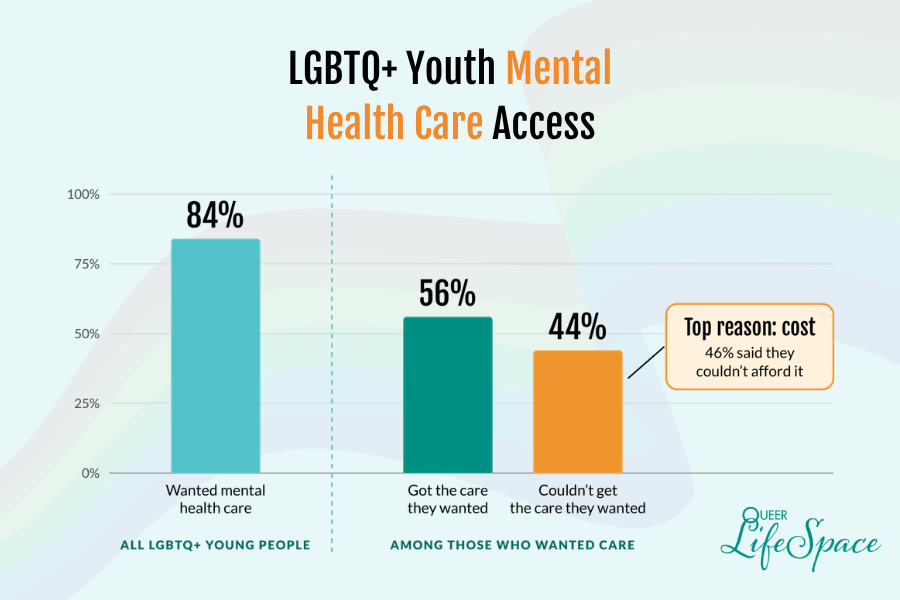
- 44% of LGBTQ+ young people who wanted mental health care in the past year couldn't get it, and cost was the most common reason.
Most people want to support the LGBTQIA+ people in their lives, but knowing what to say or do in the moment can be harder. This guide covers everyday habits of good allies, examples for home and work, and what to do right after a mistake. It also explains how allies can help more LGBTQIA+ people get affordable, affirming mental health care.
Support for LGBTQIA+ people is widespread: 74% of non-LGBTQ adults back equal rights for the community, and 61% call themselves supportive. Being an LGBT ally is how that support plays out in daily life – in the words you use, the conversations you have, and the people and organizations you stand behind. Read on for everyday ally habits and how allies can help more LGBTQIA+ people get mental health care.
We’ll discuss the following:
Want to put your support into action right away? Your gift helps keep queer-affirming therapy affordable for LGBTQIA+ people in the Bay Area!
Donate TodayWhat does “LGBT ally” mean?
An LGBT ally is someone who takes action to support lesbian, gay, bisexual, transgender, queer, and other LGBTQIA+ people. That can include learning the terms and history that shape LGBTQIA+ lives, speaking up when someone makes a hurtful comment or spreads misinformation, and supporting LGBTQIA+-led organizations that provide affirming health care, youth programs, and community events.
Allies are described as people who are willing to keep learning, work through their own barriers, and take action all the time. Allies aren’t only straight or cisgender people, either. LGBTQIA+ people can be allies to each other. For example, a cisgender gay man who shows up for his trans friends is practicing allyship too.
Why is LGBT allyship important?
Allyship helps LGBTQIA+ people feel safe and supported in the places they spend their days. Many still face unfair treatment, so a friend, coworker, or relative who stands with them can make everyday life easier.
Many LGBTQIA+ people still face unfair treatment. 64% of LGBTQ adults have experienced discrimination, including 81% of Gen Z LGBTQ adults. Allies can help by speaking up and making everyday spaces feel safer.
LGBTQIA+ people are part of nearly every circle. 9% of U.S. adults identify as LGBTQ+, more than double the share in 2012. That’s a lot of friends, coworkers, and relatives who could use an ally close by.
Young people often find support from the adults around them. 85% of LGBTQ+ students have at least one adult at school who supports and affirms who they are. Each of those adults is an ally, and anyone can become one.
When allies speak up, LGBTQIA+ people don’t have to carry every hard conversation on their own. That leaves more room to simply be themselves.
How can you be a good LGBTQ ally?
A good LGBTQ ally takes on some of the work LGBTQIA+ people often do alone, like explaining, correcting, and pushing back.
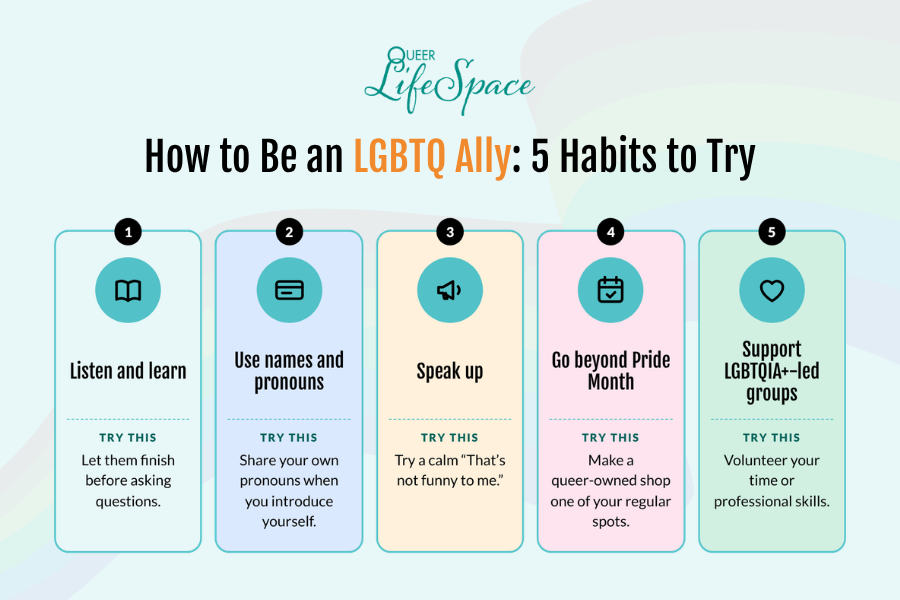
These five habits are a practical place to start:
Listen and learn on your own
Learning about LGBTQIA+ lives doesn’t have to fall solely on your queer friends. It helps to take some of that learning on yourself. A guide to common terms and respectful language is an easy place to start. Consuming books, podcasts, and films made by LGBTQIA+ creators can add a lot too, since personal stories often teach what definitions can’t.
When someone does open up about their experience, a few things can help:
Giving them space to finish. Holding your questions until they’re done shows you’re truly listening.
Taking their word for it. Their experience is theirs, even if it’s different from what you expected.
Checking in before asking more. Something like “Is it okay if I ask about that?” lets them decide how much to share.
Keeping it between you. Their identity and story are theirs to share, so it’s best to wait until they’ve said it’s okay to pass it on.
Use the names and pronouns people prefer
When asked how adults can support them, 72% named respecting their pronouns. Using the right name and pronouns consistently, including when the person isn’t in the room, helps others follow your lead.
A few habits that make this easier:
Sharing your own pronouns. Saying “I’m Sam, and I use she/her” when you introduce yourself makes it easier for others to share theirs, without putting anyone on the spot.
Asking privately if you’re not sure. A quiet “What pronouns do you use?” works better than asking in front of a group.
Using their current name, even when talking about the past. Someone’s name today is the right name for stories from before, too.
Checking who knows. Some people use different names or pronouns in different places, like at work or with family. If you’re unsure, it’s kind to ask which to use where.
Practicing they/them. If singular they feels unfamiliar, saying it out loud a few times makes it come naturally faster.
Speak up against homophobia and transphobia
Hearing a hurtful joke or comment and not knowing what to say is one of the most common moments allies face. Speaking up doesn’t need to be a big confrontation. Often, a calm word in the moment helps the person targeted feel less alone, and it shows everyone else where you stand.
A few approaches that tend to work well:
Keeping it short. Something like “That’s not funny to me” or “Let’s not talk about people that way” makes your point without starting a debate.
Asking a question. “What do you mean by that?” invites the person to explain, and often to rethink, what they just said.
Correcting misinformation gently. If someone repeats something untrue, a simple “I don’t think that’s right, actually” can open a real conversation.
Following up privately. A one-on-one chat later can land better than calling someone out in front of others, especially with friends or family.
Using the right channels at work. If comments become a pattern, a manager or HR may be the best place to raise it.
Your safety matters too. If speaking up could put you or someone else at risk, it’s okay to step back in the moment and offer support afterward instead.
Allyship beyond Pride Month
Pride Month brings a lot of visibility in June, and the other 11 months are when steady support counts most. LGBTQIA+ people’s lives don’t change when the parades end, so allyship that carries through the whole year often means the most.
A few ways to keep it going:
Marking other moments on the calendar. Pride isn’t the only time to celebrate. Awareness weeks like Bisexual Awareness Week and Nonbinary Awareness Week are good chances to learn, share, and show support.
Supporting queer-owned businesses regularly. Making them your go-to coffee shop, bookstore, or salon helps far more than a single Pride-season visit.
Giving on a schedule. A recurring gift, even a small one, helps LGBTQIA+ organizations plan ahead instead of relying on one busy month.
Following local LGBTQIA+ organizations. Their newsletters and social accounts are an easy way to hear about events, volunteer needs, and community news as they come up.
Keeping the conversation going. Sharing an article, recommending a book, or checking in with a friend matters just as much in February as it does in June.
Support LGBTQIA+-led organizations
Organizations led by LGBTQIA+ people often understand their community’s needs firsthand, because many of the people running them share those experiences. Finding one that fits your values makes it easier to stick with your support over time.
A few questions that can help you choose:
Who leads it? Look for LGBTQIA+ people in leadership and on staff, not only in the photos.
Who does it serve? Some groups focus on youth, trans people, or a specific city or region. Picking one whose focus matters to you keeps you invested.
What does your support pay for? Many nonprofits share program details, impact numbers, or annual reports on their websites.
Is it local? Local groups can be easier to get involved with in person, and your support stays close to home.
Once you’ve found one, a few ways to help:
Donating, even a small amount. Smaller nonprofits often feel the impact of every gift.
Volunteering your time or skills. Event help, design, photography, writing, or legal and financial know-how all come in handy.
Checking your employer’s programs. Some companies offer volunteer grants or paid volunteer time off.
Sharing their work. Passing along an event or post helps them reach people they wouldn’t find on their own.
Queer LifeSpace is one example in the Bay Area. The San Francisco nonprofit provides clinical training and accessible mental health services for economically vulnerable LGBTQIA+ people in California. Volunteers there help with everything from planning fundraisers to mentoring in youth programs like Outlandish! and EQUARTY.
What are some examples of LGBTQ allyship?
Everyday allyship often happens in small, ordinary moments: a family dinner, a team meeting, a conversation with a neighbor. Each setting comes with its own chances to make LGBTQIA+ people feel welcome.
At home and with family
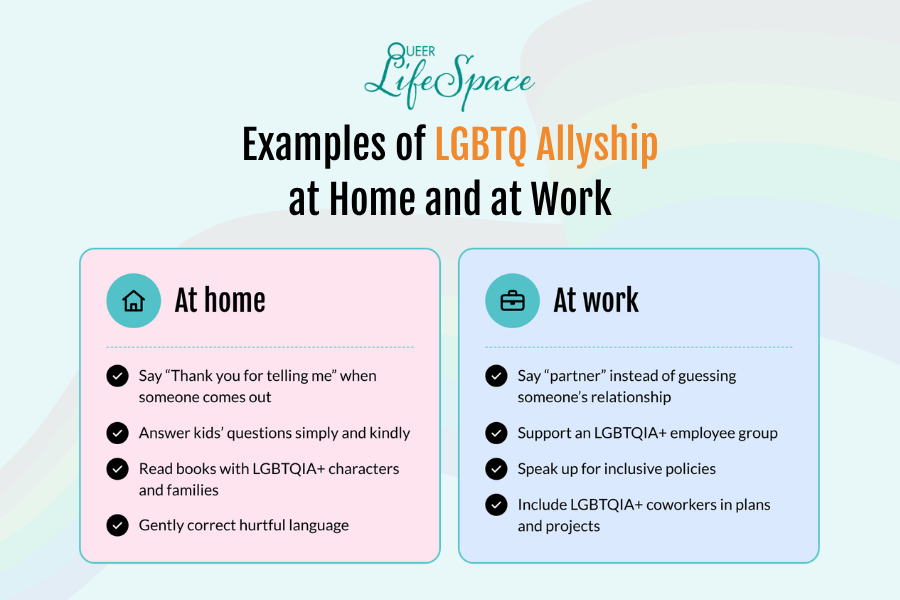
Home is often where people decide whether it’s safe to be themselves. If someone comes out to you, a simple “Thank you for telling me” can mean a lot. You can also ask whether they’ve told anyone else. That way, you won’t mention it to someone who doesn’t know yet.
If you have kids, the way you talk about LGBTQIA+ people at home shapes how they see the world. 93% of U.S. adults surveyed say children should be taught to accept people as they are.
A few everyday ways to do that:
Answering questions simply. If your child asks why a classmate has two dads, something like “Families come in lots of different shapes” is often all they need.
Reading books with LGBTQIA+ characters and families. Stories make different kinds of families feel familiar, not unusual.
Gently correcting hurtful language. If “that’s so gay” comes home from school, it’s a good chance to talk about why words like that can hurt.
Keeping the door open. Talking about LGBTQIA+ people openly and kindly lets your kids know they can come to you, whoever they turn out to be.
At work
Visible support at work makes a real difference. In one survey, over 90% of LGBTQ employees whose employers took visible supportive steps were satisfied with their jobs, compared with less than three-fourths of those whose employers didn’t.
Coworkers can help create that kind of workplace, too:
Using inclusive language in meetings, like “partner” or “spouse” instead of assuming someone’s relationship.
Joining or supporting an LGBTQIA+ employee resource group, if your workplace has one.
Speaking up for inclusive policies, like gender-neutral restrooms or inclusive health benefits.
Including LGBTQIA+ coworkers in plans and conversations, from lunch invites to stretch projects.
What should you do if you make a mistake as an ally?
Apologize briefly, correct yourself, and move on. Allies can slip up, whether it’s using the wrong pronoun or asking a question that’s too personal. What matters is how you handle it, and that the moment stays focused on the other person rather than your guilt.
Say sorry once. A long apology puts the other person in the awkward spot of reassuring you.
Correct yourself and continue. Repeat the sentence the right way and finish your point.
Don’t ask for comfort. It’s not their job to tell you it’s okay.
Practice in private. If a name or pronoun is new to you, say it out loud a few times when you’re alone.
Thank the people who correct you. A simple “thanks” makes it easier for others to speak up next time.
How can allies support LGBTQIA+ mental health?
Affordable, affirming mental health care is hard to find, and allies can help fund it. Among LGBTQ+ young people who wanted mental health care in the past year, 44% couldn’t get it. The most common reason was cost, with 46% saying they couldn’t afford it.
That’s the gap you can help close. Queer LifeSpace offers therapy services on a sliding scale and matches clients with clinicians who understand and share their lived experiences. Since 2011, supporters like you have helped Queer LifeSpace serve thousands of clients and deliver tens of thousands of therapy sessions.
Your gift also supports training the next generation of queer-affirming therapists. They learn to provide queer-affirming care, where therapists understand how identity, stigma, and mental health can overlap.
You've read what allyship looks like. The next step is the one that reaches someone directly: helping an LGBTQIA+ person in the Bay Area sit down with a therapist who gets it, at a price they can manage.
Donate TodayFrequently asked questions
-
The A generally refers to asexual, aromantic, and agender people. Some style guides list ally as another meaning, though some people object to using it that way.
-
Yes. The community includes many different experiences, so LGBTQIA+ people can be allies to each other. A cisgender lesbian, for example, can be an ally to nonbinary people.
-
You can, but the label means less than the actions behind it. Many people prefer to let their actions speak and let LGBTQIA+ people decide whether they’ve been a good ally.
-
An ally supports LGBTQIA+ people in their own daily life. An advocate usually takes it further, pushing for change through policy, organizing, or public work. Many people start as allies and grow into advocates.
-
Use the names and pronouns trans people share, don’t ask invasive questions about their bodies or medical history, and speak up when you hear misinformation.