- LGBTQIA+ stands for lesbian, gay, bisexual, transgender, queer or questioning, intersex, and asexual. The plus covers people who use other terms.
Read full summary ▾
- About 9% of U.S. adults identify as LGBTQ+.
- More than half of LGBTQ+ adults identify as bisexual, making bisexual people the largest group in the community.
- About 1.5 million LGBT adults live in California, more than in any other state.
- A 2024 meta-analysis of 167 studies found that LGBTQ+ people who felt connected to their community tended to have better mental health, well-being, and physical health.
The LGBTQ community covers a lot of identities, and the words used to describe it have changed over the decades. This guide explains what each letter in LGBTQIA+ means, how the acronym grew, and where the modern movement began. It also covers why community connection matters and how you can support it.
LGBTQ stands for lesbian, gay, bisexual, transgender, and queer, but the community it describes is broader than those five letters. It includes anyone whose sexual orientation or gender identity isn’t straight or cisgender, and the history and culture they share.
At Queer LifeSpace, a nonprofit built by and for queer people, we use LGBTQIA+, which includes intersex and asexual people. You’ll see both terms here.
We’ll discuss the following:
Want to help the community? Your gift funds affordable therapy, training for the next generation of queer-affirming therapists, and programs that get LGBTQIA+ youth outdoors.
Fund Queer-Affirming CareWho is part of the LGBTQ community?
The LGBTQ community is the group of people whose sexual orientation or gender identity differs from straight and cisgender, along with the networks, spaces, and shared history they’ve built. It includes people of every race, age, ability, and background.
For many LGBTQ people, community means having people they can relate to and places where they feel accepted. This can include finding others who share similar experiences or getting support through a difficult time. These connections can make it easier to feel less alone and find support when dealing with relationships, family, or other parts of life.
What does LGBTQIA+ stand for?
The acronym “LGBTQIA+” stands for lesbian, gay, bisexual, transgender, queer or questioning, intersex, and asexual. The plus sign includes people who describe themselves with other terms. Each letter describes a sexual orientation, a gender identity, or a variation in sex characteristics.
Each letter means:
Lesbian: Typically, a woman who is sexually attracted to other women.
Gay: Traditionally used to describe a man who is sexually attracted to other men, the term has evolved to include people of any gender who are attracted to the same sex or gender. It can also describe women who love women, including lesbians and other sapphic people.
Bisexual: People sexually attracted to two or more genders.
Transgender: People whose gender identity differs from the sex they were assigned at birth. For example, someone assigned female at birth may identify as a man, or someone assigned male at birth may identify as a woman. Some transgender people identify outside the categories of man and woman. Being transgender doesn’t depend on whether someone has changed their name, appearance, or body through medical treatment.
Queer: Once used as an insult, the word has been reclaimed by many LGBTQ people as a way to describe their identity. It can serve as a broader, more inclusive term for people whose sexual orientation or gender identity doesn't fit traditional categories.
Questioning: People who are uncertain about their sexual orientation or gender identity, whether for a while or for the long term.
Intersex: People with variations in sex characteristics, such as chromosomes, reproductive organs, or genitalia, that fall outside what’s typically categorized as male or female.
Asexual: People who lack sexual attraction or interest in sexual expression.
Plus (+): People who are part of sexual and gender diverse communities but use other terms to describe themselves.
Sexual orientation vs. romantic orientation vs. gender identity
These three terms describe different aspects of a person's identity:
Sexual orientation describes who you're sexually attracted to, such as men, women, people of multiple genders, or no one.
Romantic orientation describes who you develop romantic feelings for or want to form romantic relationships with. This may or may not align with your sexual orientation.
Gender identity is your internal sense of your own gender. You might identify as a man, a woman, nonbinary, both, neither, or another gender.
These distinctions are important because attraction and gender aren't the same thing. For example, a transgender person can be straight, gay, lesbian, bisexual, or queer. Someone can also experience romantic attraction to one gender but sexual attraction to another.
How has the LGBTQ acronym evolved over time?
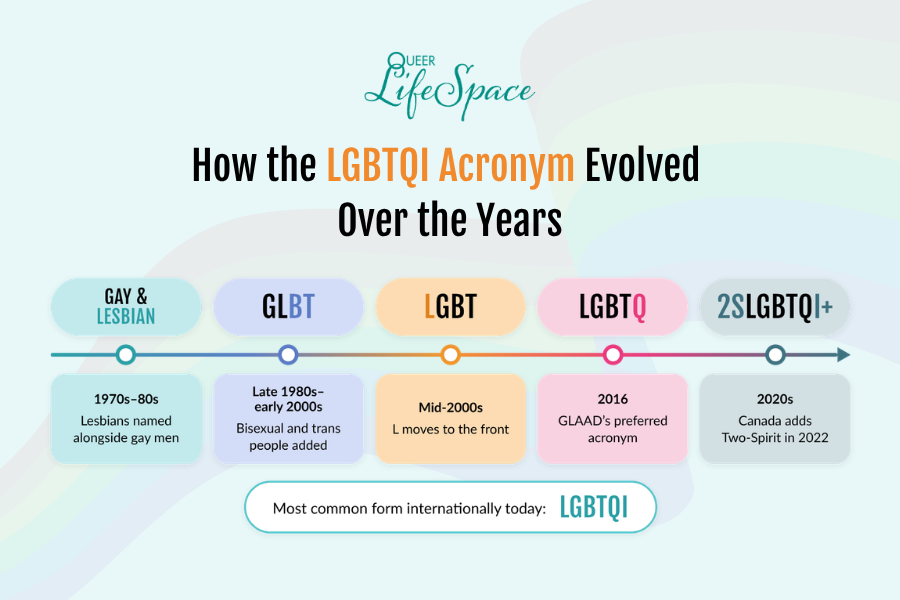
The acronym has evolved over time to reflect more of the identities within the community. “Gay” started as a catch-all, lesbians were named explicitly in the 1980s, and bisexual and transgender people were added over the following decade or so. Longer versions like LGBTQIA+ came later.
1970s and 1980s
“Gay” was the main umbrella term, mostly covering gay men and lesbians. In the 1980s, groups began naming lesbians directly. The National Gay Task Force, for example, became the National Gay and Lesbian Task Force.
Late 1980s to early-2000s
Bisexual and transgender people weren’t added to the acronym all at once. Each group had to push for recognition, one organization at a time. In 1992, bisexual activists got “Bi” added to the name of the 1993 March on Washington, but transgender people were left out of the title.
Over the next decade, more groups made room for both. The National Gay and Lesbian Task Force added bisexual and transgender people to its mission in 1997, and San Francisco’s Gay and Lesbian Historical Society became the GLBT Historical Society in 1999. By the early 2000s, GLBT was a common way to name the community.
Mid-2000s
LGBT replaced GLBT as the most common term, putting lesbians first. “Gay” had long been read as meaning men, leaving lesbians in the background. According to Ross Murray of the GLAAD Media Institute, leading with L is a way to recognize that lesbians face both sexism and homophobia.
2016
In October 2016, GLAAD’s Media Reference Guide began encouraging journalists to use LGBTQ as the preferred acronym, calling it the most inclusive way to describe the community. GLAAD also added “queer” to its own mission that year. The recommendation carried weight because GLAAD’s guide has informed the style guides of the Associated Press, Reuters, and The New York Times.
2020s
The acronym keeps expanding to name more people. In August 2022, Canada’s federal government adopted 2SLGBTQI+ after a public consultation. It added Two-Spirit (2S) at the front to recognize Indigenous people’s presence before Western colonization. Different versions still exist side by side, and internationally, LGBTQI tends to be the more common form.
How big is the LGBTQ community in the U.S.?
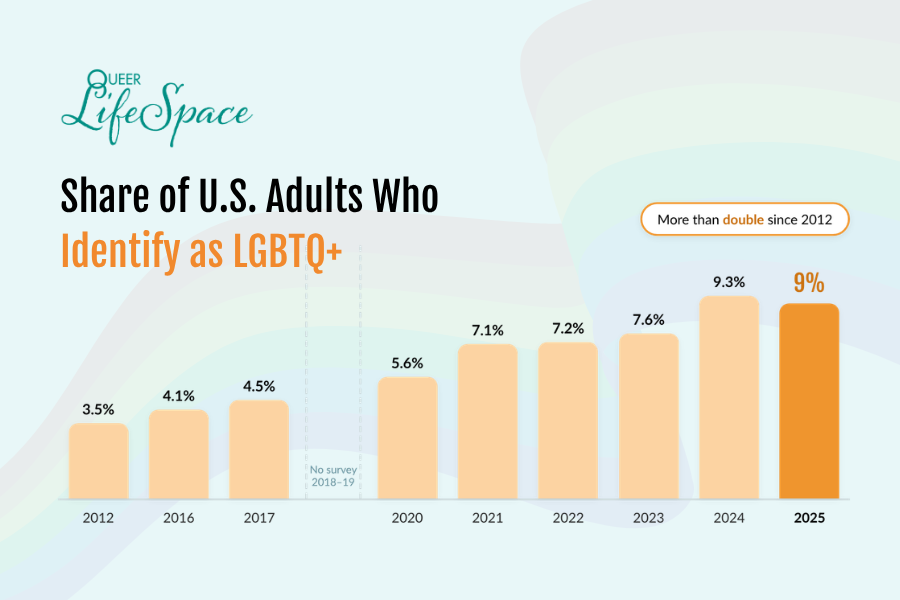
About 9% of U.S. adults identify as LGBTQ+, according to Gallup’s 2025 polling. That’s more than double the 3.5% Gallup recorded in 2012, the first year the poll took place. Another 86% of adults identify as heterosexual, and 5% didn’t answer.
What the numbers show:
Bisexual people are the largest group. More than half of LGBTQ+ adults identify as bisexual.
Gay, lesbian, and transgender people follow. Among LGBTQ+ adults, 17% identify as gay, 16% as lesbian, and 12% as transgender.
Bisexual identification is climbing. The share of all U.S. adults who identify as bisexual rose from 3.1% in 2020 to 5.3%.
Younger adults are driving growth. About 23% of adults under 30 identify as LGBTQ+, compared with 3% or less of adults 50 and older.
Women identify at higher rates than men, mainly because more women identify as bisexual.
What about California?
The Williams Institute at UCLA estimates that about 1.5 million LGBT adults live in California, more than in any other state. That estimate comes from 2020 to 2021 federal health survey data and uses a different method than Gallup, so the two numbers don’t line up exactly.
Nearly one in ten adults is part of this community, and many can’t afford consistent, affirming care. When you give, you help someone sit down with a therapist who already understands who they are, or help a queer teen spend a day on the trail.
Fund Queer-Affirming CareWhere did the modern LGBTQ community come from?
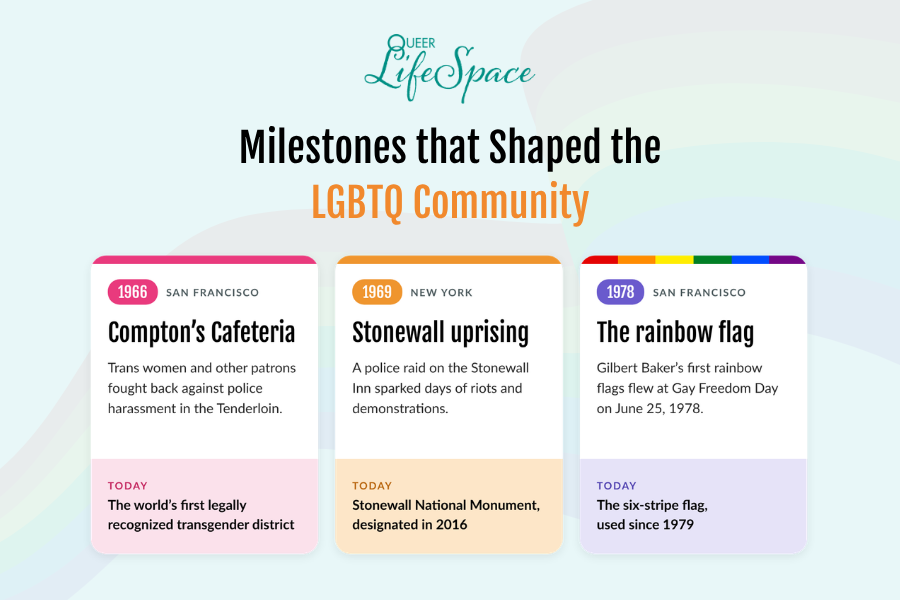
The modern LGBTQ community took shape through decades of organizing. Some of the best-known turning points happened in San Francisco and New York in the 1960s and 1970s, when people started pushing back in public and building symbols of their own.
Compton’s Cafeteria, 1966
In 1966, trans women and other patrons at Gene Compton’s Cafeteria, a 24-hour spot in San Francisco’s Tenderloin, fought back against police harassment. Historian Susan Stryker calls it the first known instance of collective militant queer resistance to police harassment in U.S. history.
The August 1966 riot became a milestone. In the years after, the San Francisco Department of Public Health’s Center for Special Problems offered some of the nation’s first social services for transgender people. Today, the area is the Compton’s Transgender Cultural District, the first legally recognized transgender district in the world.
Stonewall, 1969
After a June 28, 1969 police raid on the Stonewall Inn, a well-known LGBT bar in New York’s Greenwich Village, riots and demonstrations continued in the neighborhood for days. The uprising is widely credited with sparking the modern LGBT civil rights movement. In 2016, the site became Stonewall National Monument, the first National Park Service unit dedicated to telling the story of LGBT Americans.
The rainbow flag, 1978
Ahead of San Francisco’s 1978 Gay Freedom Day, Supervisor Harvey Milk and other local activists asked artist Gilbert Baker to create a new symbol for the community. Baker and a team of volunteers and friends hand-dyed and stitched two eight-stripe rainbow flags, which flew at United Nations Plaza on June 25, 1978. The pink and turquoise stripes were dropped for the 1979 parade, creating the six-stripe version most people know today.
Milk was assassinated in November 1978. For the next year’s parade, Baker worked with a local flag company to line the streets with hundreds of rainbow flags.
Why is LGBTQIA+ community and social support important?
Feeling connected to other LGBTQ people is linked to better health. A 2024 meta-analysis of 167 studies found that connection with LGBTQ+ communities was associated with better mental health, well-being, and physical health. The effects were modest, and the link was more complicated for younger people and those with multiple marginalized identities.
LGBTQ people find community in different ways. It might be a support group, a sports team, a group chat, or the people they consider family. Our post on how LGBTQIA+ college students build community explores how these connections happen both online and in person.
How Queer LifeSpace helps LGBTQIA+ people find community and support
Queer LifeSpace offers many ways for LGBTQIA+ people to connect with others, access affirming mental health care, and explore shared interests.
Our programs include:
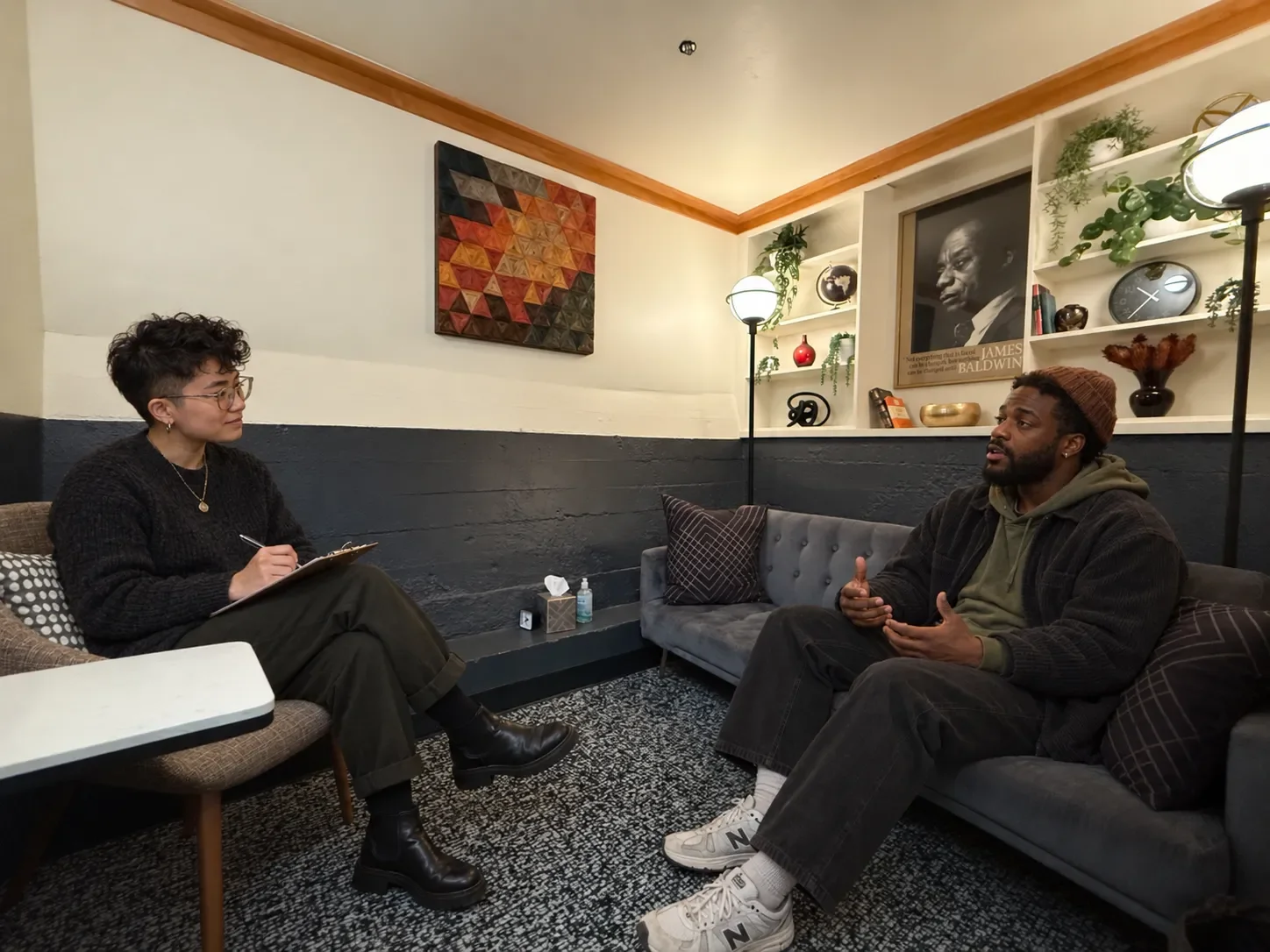
Therapy: Queer LifeSpace offers sliding-scale therapy to California residents in three formats:
In one-on-one therapy, each client is matched with a clinician based on shared lived experience and clinical approach.
Relationship therapy supports couples, polyamorous and open relationships, and families.
Identity-based group therapy brings together gay men, queer women, gender-diverse people, neuroqueer clients, queer and trans BIPOC clients, and people in polyamorous or non-monogamous relationships.
Outlandish!: Guided hikes and sailing trips for LGBTQIA+ youth ages 13 to 18 across San Francisco, San Mateo, the East Bay, and Marin.
EQUARTY: Mental health and arts resources for emerging queer artists ages 18 to 30 in the Bay Area.
Youth Services: Affirming therapy for queer youth ages 12 to 24 across Northern California, with sessions tailored to each young client’s needs. Each year, donors fund a set number of free spots, offered first come, first served, so youth without income or family support can still get care.
Rural Youth Outreach: Free individual and group counseling, fully funded by donors, for LGBTQIA+ students from low-income backgrounds in rural California, where queer-affirming resources at school or in town are limited or nonexistent. The program started in 2017 at Los Banos High School in the Central Valley and now serves all of Northern California’s rural counties.
Clinical training: Our internationally recognized program trains the next generation of queer-affirming therapists, so more people can find care from someone who understands them.
Each program is built on queer-affirming care, where clients don’t have to explain or defend who they are before the work begins.
How can you support the LGBTQ community?
Supporting the LGBTQ community doesn’t take a big gesture. Most of it comes down to everyday choices about how you treat people and where you put your time and money.
Here’s where to start:
Use the words or labels people use for themselves. If you’re not sure, ask, and follow their lead.
Show up. Queer LifeSpace hosts fundraisers throughout the year, from immersive theater nights to floral design parties.
Give locally. Over 15 years, Queer LifeSpace has served nearly 8,000 clients, delivered more than 60,000 therapy sessions, and trained more than 150 queer-affirming clinicians. Fundraising helps close the gap between what therapy costs to provide and what many clients can afford to pay, and your support helps make it possible.
Volunteer your time or skills. Event help, outreach, and professional skills all keep small nonprofits running.
Speak up. When you hear misinformation, correct it, and share what you’ve learned.
You can be part of this community’s support system
LGBTQIA+ people have often built their own support systems when other help wasn’t there. Your gift helps fund one of them: affordable therapy sessions, training for new queer-affirming therapists, and programs for young people who need care the most.
Fund Queer-Affirming CareFrequently asked questions (FAQs)
-
Yes. Both terms describe the same community. LGBTQIA+ spells out more identities, including intersex and asexual people, while LGBTQ is shorter. Organizations tend to choose the version that best fits the people they serve. Queer LifeSpace uses LGBTQIA+ to reflect the full range of clients and communities we work with.
-
The plus sign includes people who are part of sexual and gender diverse communities but use other terms to describe themselves. It keeps the acronym open-ended, since the language around gender and sexuality keeps evolving as people find words that fit their experiences.
-
Cisgender describes people whose gender identity matches the sex they were assigned at birth. It’s the counterpart to transgender. For example, someone assigned female at birth who identifies as a woman is cisgender.
-
Allies are straight and cisgender people who support LGBTQ people and their rights. They can show up as volunteers, donors, and event guests, but allies usually aren’t counted in the acronym itself. Adding allies has been debated, since some see an “A” for allies as pushing out asexual, aromantic, and agender people.
-
“Queer” was used as an insult for much of the 20th century. Many LGBTQ people have since reclaimed it, particularly younger people who find gay, lesbian, or bisexual too limiting. It isn’t universally accepted, though, and some people still avoid the word because of its history.